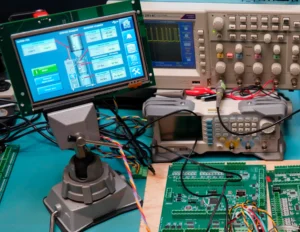
As connected products become smarter and more capable, the line between hardware and software continues to blur. Today’s devices — from IoT sensors and smart home products to industrial controllers and wearable technology — depend just as much on embedded firmware as they do on the printed circuit boards beneath them. For OEMs working with Thomas Instrumentation, custom firmware development is not an isolated service. It is a critical layer that complements PCB design, electronics manufacturing, and system reliability across a wide range of device categories.
While firmware is often associated with IoT, its role extends far beyond connected devices. Any product that includes a microcontroller, processor, or programmable logic relies on firmware to translate hardware capability into real-world functionality. This guide explores how custom firmware development for devices supports smarter, more reliable products — and why integrated hardware–software design is essential for modern electronics built in the USA.
Why Firmware Matters Beyond IoT
Firmware as the Bridge Between Hardware and Function
Firmware sits between physical electronics and end-user behavior. It controls how components interact, how power is managed, how data flows, and how a device responds to real-world conditions. Without well-designed firmware, even the most robust PCB cannot perform as intended.
Firmware responsibilities often include:
- Hardware initialization and control
- Power management and efficiency optimization
- Sensor data acquisition and processing
- Communication with external systems
- Safety monitoring and fault handling
- Supporting intuitive user interaction
Whether the device is a smart thermostat, a wearable health monitor, or an industrial control module, firmware defines not only how reliably and efficiently it operates, but also how intuitive and user-friendly the experience is for the end user.
Expanding Use Cases Across Industries
Custom firmware development applies to far more than consumer IoT products. Common applications include:
- Smart home and building automation devices
- Wearables and personal electronics
- Industrial sensors and controllers
- Diagnostic and monitoring equipment
- Battery-powered and low-energy devices
As electronics become more specialized, off-the-shelf firmware is often insufficient. OEMs increasingly require custom solutions tailored to their hardware, use case, and performance requirements.
The Relationship Between PCB Design and Firmware
Hardware and Software Are Interdependent
Firmware cannot be developed in isolation. Pin assignments, power rails, clock sources, memory architecture, and peripheral selection all influence how firmware is written and optimized.
Close integration between PCB design and firmware development enables:
- Efficient use of processing resources
- Optimized power consumption
- Faster bring-up and debugging
- Reduced risk of late-stage design changes
From first-hand experience in electronics development environments, many device issues attributed to “software bugs” are actually the result of mismatches between hardware design assumptions and firmware behavior.
Design Decisions That Affect Firmware Performance
Key PCB design elements that influence firmware include:
- Microcontroller or processor selection
- Memory layout and availability
- Power regulation and stability
- Signal integrity for communication interfaces
- Debug and programming access
When firmware developers are involved early, these factors can be aligned to support long-term reliability and scalability.
Custom Firmware Development: What It Really Includes
Low-Level Hardware Control
At the foundational level, firmware must reliably control hardware components. This includes configuring registers, managing interrupts, and ensuring peripherals behave as expected.
Low-level firmware responsibilities include:
- Bootloader development
- Peripheral drivers (GPIO, ADC, timers, etc.)
- Startup and initialization routines
Stable low-level control is essential for device reliability, especially in products that operate unattended.
Device Logic and Application Behavior
Above the hardware layer, firmware implements device-specific logic. This is where product differentiation often occurs.
Examples include:
- Control algorithms for motors or actuators
- Sensor calibration and data filtering
- Event handling and state management
- User interface logic for displays or indicators
Custom firmware allows OEMs to tailor device behavior precisely to their application.
Communication and Connectivity
Many modern devices require some form of communication, whether wired or wireless. Firmware handles the protocols that enable this connectivity.
Common interfaces include:
- USB, UART, SPI, and I²C
- Ethernet and industrial fieldbuses
- Bluetooth, Wi-Fi, and other wireless protocols
For IoT device electronics in the USA, secure and reliable communication is a core firmware responsibility.
Firmware’s Role in Reliability and Longevity
Error Handling and Fault Recovery
Well-designed firmware anticipates failures and responds gracefully. In real-world environments, power fluctuations, sensor faults, and communication errors are inevitable.
Firmware reliability features often include:
- Watchdog timers
- Safe-state handling
- Fault logging and diagnostics
- Automatic recovery routines
These capabilities reduce downtime and prevent minor issues from becoming catastrophic failures.
Supporting Long Product Lifecycles
Many devices — particularly industrial and professional equipment — are expected to remain in service for years. Firmware must be maintainable and adaptable over time.
Lifecycle-focused firmware supports:
- Field updates and enhancements
- Bug fixes without hardware changes
- Compatibility with component substitutions
From an industry perspective, firmware flexibility significantly reduces the cost and disruption associated with product updates.
Power Management and Efficiency
Critical for Battery-Powered Devices
Power efficiency is a major concern for wearables, sensors, and portable devices. Firmware plays a central role in managing energy consumption.
Efficiency strategies include:
- Sleep and low-power modes
- Intelligent sensor sampling
- Dynamic clock and voltage control
- Event-driven processing
According to the U.S. Department of Energy, software-based power optimization can extend device battery life by 20–40%, depending on the application.
Aligning Firmware with Hardware Capabilities
Effective power management requires close alignment between PCB power design and firmware control logic. Regulators, power domains, and measurement points must be accessible and controllable through firmware.
Security and Firmware
Embedded Security Starts in Firmware
As devices become more connected, security is no longer optional. Firmware is the first line of defense against unauthorized access and malicious behavior.
Firmware security considerations include:
- Secure boot and code authentication
- Encrypted communication
- Access control and permissions
- Protection against firmware tampering
For connected products, weak firmware security can undermine otherwise robust hardware designs.
Supporting Compliance and Trust
Security-focused firmware supports compliance with industry standards and customer expectations. It also builds trust with end users who rely on device integrity and data protection.
The Value of USA-Based Firmware and Electronics Integration
Faster Collaboration and Iteration
Developing firmware alongside PCB design in USA-based environments allows tighter collaboration between engineers. Issues can be identified and resolved earlier, reducing delays and rework.
Benefits include:
- Faster prototyping and validation
- Improved communication between disciplines
- Better alignment with customer requirements
Thomas Instrumentation supports integrated development approaches that reduce friction between hardware and software teams.
Quality and Accountability
Domestic development environments often emphasize documentation, testing, and traceability. These practices improve firmware quality and simplify long-term maintenance.
For OEMs, this translates into fewer surprises and more predictable outcomes.
Testing and Validation of Firmware-Driven Devices
Beyond Functional Testing
Firmware must be validated under real-world conditions. This includes stress testing, edge cases, and long-duration operation.
Validation activities often include:
- Hardware-in-the-loop testing
- Environmental and power variation testing
- Communication stress testing
- Long-term stability testing
Firmware issues discovered late in the process are costly. Early and thorough validation reduces risk.
Supporting Manufacturing and Field Support
Firmware also supports manufacturing test processes and post-deployment diagnostics. Built-in test routines and logging capabilities simplify both production and service.
What OEMs Should Look for in Custom Firmware Development
When evaluating firmware partners, OEMs should consider:
- Experience across multiple device types
- Ability to integrate with custom PCB designs
- Focus on reliability, security, and lifecycle support
- USA-based development and collaboration
- Alignment with manufacturing and testing processes
Custom firmware is most effective when it is treated as a core part of product design, not an afterthought.
FAQs About Custom Firmware Development
1. What is custom firmware development?
It is the creation of embedded software tailored to specific hardware and device requirements, rather than using generic or prebuilt code.
2. Is firmware only for IoT devices?
No. Firmware is used in wearables, industrial equipment, diagnostics, consumer electronics, and many other device types.
3. Why should firmware be developed alongside PCB design?
Early integration improves performance, reduces errors, and ensures hardware capabilities are fully utilized.
4. How does firmware affect device reliability?
Firmware controls error handling, power management, and recovery behavior, all of which directly impact reliability.
5. Can firmware be updated after devices are deployed?
Yes. Well-designed firmware supports updates, bug fixes, and enhancements throughout the product lifecycle.
Turning Electronics Into Intelligent Products
Custom firmware development is what transforms electronic assemblies into intelligent, responsive devices. When embedded software is developed in close coordination with PCB design, the result is a product that performs reliably, efficiently, and securely — whether it is an IoT sensor, a wearable, or an industrial controller.
By taking an integrated approach to custom firmware development for devices, Thomas Instrumentation helps OEMs build electronics that are not only functional but adaptable and future-ready. In a market where differentiation depends on performance and reliability, firmware is no longer just a technical detail — it is a strategic advantage.